


A new partnership for London’s researchers and policymakers

About this initiative
London has an extraordinary wealth of research to draw on. It has one of the world’s greatest concentrations of academic expertise, with its universities producing internationally recognised work across fields central to the future of cities and many of the challenges facing London.
To make the most of this expertise, a new partnership is being developed between the GLA, London Councils, London Higher and the Universities Policy Engagement Network (UPEN) to strengthen collaboration between London’s research and policy communities.
Our vision
We will build on existing strategic partnerships and networks to act as a catalyst for new creative ways for policymakers to access the evidence and insight within our institutions; to give researchers clearer routes into the policy questions where their research can make a difference; and to build shared research agendas to better serve London’s needs.
As devolution creates new opportunities to shape London’s future at a regional level, policymakers need more than ever to have timely access to the best evidence, insight and expertise.
The partnership will also work together to ensure that London’s challenges are reflected in national research agendas and funding programmes, and demonstrate nationally and internationally what effective collaboration between a major city-region, its universities and its policymakers can achieve.
London’s Research Ecosystem
A national asset: London’s research ecosystem is a powerhouse of innovation and development. From cutting-edge medical breakthroughs to sustainable environmental solutions, the research undertaken in the capital drives progress and prosperity right across the country. Returns flow across the UK through collaboration, supply chains, spin-outs, graduates and inward investment.
Complementary, not competitive: World-leading expertise in sustainability, social sciences, urban transformation, public service reform, economic growth, crime and safety, and health and wellbeing can be leveraged by policymakers to inform decision-making that tackles the most pressing societal challenges.
A global gateway: The comparisons for London are other global cities – Boston, New York, Singapore and Paris. Investment decisions here are about whether the UK keeps a world-leading position, not about how a UK share is divided.
Excellence and investment: 47% of London’s research was rated 4* (world-leading) in the REF 2021 results, demonstrating the world-class outputs derived from research spend in the capital. The UK attracted $17bn in venture capital in H1 2026, its strongest first half since 2022 and double the previous year. London accounted for $14bn of it. The UK now takes 41% of all European deep tech and life sciences funding, up from 23% a year earlier. London is number one in Europe for life sciences venture capital investment.
Get involved
The partnership will trial a range of approaches, from rapid evidence and expert brokerage to longer-term collaborations around London’s strategic challenges.
Visit our partners’ websites for more information on the partnership, Areas of Research Interest for London, and more:
- Greater London Authority – City Intelligence Unit
- London Councils
- UPEN
See our upcoming events.
For more information on the partnership or expert brokerage function, please contact Darren de Souza darren.desouza@londonhigher.ac.uk.
LUMEN – London Universities’ Knowledge Mobilisers Engagement Network
The LUMEN Directory is a living map of the people working at the intersection of research, policy and practice across London’s universities. These are the knowledge mobilisers of London: specialists who turn academic insights into action, and policy challenges into shared research opportunities.
Subscribe to the LUMEN network to receive updates from across the network and to get in touch with colleagues about opportunities, events and funding.
Explore the directory
Birkbeck, University of London
Birkbeck's Research Strategy up to 2030 is focused on digital, data, artificial intelligence, enterprise, finance, leadership, health, mind, well-being, heritage, histories, cultures and social justice, nature, environment and sustainability.
| Name | Organisation | Role | |
|---|---|---|---|
| Josh Allen | Birkbeck, University of London | Impact and Knowledge Exchange, Faculty of Humanities and Social Sciences | j.allen@bbk.ac.uk |
| Matt Kimberley | Birkbeck, University of London | Impact and Knowledge Exchange Manager | m.kimberley@bbk.ac.uk |
More information can be found on their website.
Brunel University of London
Brunel University of London focuses its research expertise around five strategic challenges of communities, digital, health, manufacturing and sustainability. It is also served by a dedicated policy unit.
| Name | Organisation | Role | |
|---|---|---|---|
| Justin Fisher | Brunel University of London | Director of Brunel Public Policy | justin.fisher@brunel.ac.uk |
| Rosanna Smith | Brunel University of London | Manager of Brunel Public Policy | rosanna.smith@brunel.ac.uk |
More information can be found on their website.
City St George's, University of London
City St George's has particular strengths with links to business and the professions. The Finsbury Institute is the new outward-facing hub for policy, research and practice.
| Name | Organisation | Role | |
|---|---|---|---|
| Kanan Barot | City St George's, University of London | Assistant Vice-President, Civic Planning and Development | kanan.barot@city.ac.uk |
| Caroline (Cassie) Sipos | City St George's, University of London | Business Development Manager | caroline.sipos@city.ac.uk |
More information can be found on their website.
The George Institute for Global Health
The George Institute's research addresses some of the world's biggest health challenges, focusing on areas like women's health, planetary health and food policy.
| Name | Organisation | Role | |
|---|---|---|---|
| Emma Feeny | The George Institute for Global Health | Chief Impact Officer | efeeny@georgeinstitute.org |
More information can be found on their website.
Goldsmiths, University of London
Goldsmiths, University of London groups its research into themes that align with core societal challenges: health and wellbeing; creative production and immersive technology and experience; urban living; inequalities, displacement and migration; and digital and environmental futures.
| Name | Organisation | Role | |
|---|---|---|---|
| Stefani Tasheva | Goldsmiths, University of London | Policy and Engagement Officer | s.tasheva@gold.ac.uk |
More information can be found on their website.
Imperial College London
Imperial College London has a strategic vision that covers science, technology, engineering, medicine and business (STEMB) subject areas. It has a vast ecosystem of institutes and innovation hubs centred on the overarching strategic vision of 'Science for Humanity'.
| Name | Organisation | Role | |
|---|---|---|---|
| Kate Ingleby | Imperial College London | Public Affairs Manager | k.ingleby@imperial.ac.uk |
| Pete Ford | Imperial College London | Programme Manager (Imperial Policy Forum) | p.ford@imperial.ac.uk |
More information can be found on their website.
King's College London
King's College London has a Strategic Vision 2029 with five core areas:
- Educating future leaders and change-makers
- Challenging ideas and driving change through research
- Giving back to society through meaningful service
- Working with our local communities in London
- Fostering global citizens with an international perspective
| Name | Organisation | Role | |
|---|---|---|---|
| Ed Stevens | King's College London | Faculty of Arts & Humanities | edward.stevens@kcl.ac.uk |
| Jim Collins | King's College London | Director of Strategy & Operations | jim.collins@kcl.ac.uk |
| Olivia Keenan | King's College London | Knowledge Exchange Manager | olivia.keenan@kcl.ac.uk |
More information can be found on their website.
London Business School
London Business School focuses on the challenges facing the world, and how business needs to adapt to an unpredictable world while also leading in problem-solving to address them.
Areas of research include:
- ESG (environmental, social and governance) measurements
- Ageing populations
- Diversifying boardrooms
- New working world
- Climate change
- Colonial legacies
- Social mobility
- 'Last mile' problem solving
- Healthcare
| Name | Organisation | Role | |
|---|---|---|---|
| Claire Van der Vegt | London Business School | Assistant Director, Research Support & PhD Programme | cvandervegt@london.edu |
More information can be found on their website.
London Metropolitan University
London Metropolitan University has a focus on health science and policy, arts research, business studies, applied social studies and social sciences. Its research clusters around allied health, area studies, art and design, and education address complex issues such as educational inequality, environmentally friendly urban policy, ethical business practices and changing working lives.
| Name | Organisation | Role | |
|---|---|---|---|
| Claire Renwick | London Metropolitan University | Head of Business Engagement | c.renwick@londonmet.ac.uk |
| Jen Ng | London Metropolitan University | Head of Projects, School of Art, Architecture and Design | j.ng@lond |
LSE: The London School of Economics and Political Science
The London School of Economics and Political Science (LSE) is organised around 29 departments and institutes and associated research centres, covering the breadth of the social sciences, underpinned by its Research for the World 2030 strategy.
| Name | Organisation | Role | |
|---|---|---|---|
| Anthony Ashurst | London School of Economics and Political Science | London Communications |
London School of Hygiene and Tropical Medicine
The London School of Hygiene & Tropical Medicine (LSHTM) addresses major global challenges and opportunities in human health. This includes a focus on health inequities, the impact of climate and environmental change on health, pandemic preparedness, harnessing the potential of data science, strengthening capacity, and working in partnership to translate knowledge into policy and practice.
| Name | Organisation | Role | |
|---|---|---|---|
| Alexandra Anderson | London School of Hygiene & Tropical Medicine | Knowledge Exchange Lead, Strategic Research Office | alexandra.anderson@lshtm.ac.uk |
More information can be found on their website.
London South Bank University
London South Bank University (LSBU) is a sector leader in professional and technical education, collaborating with industry to train 3,000 apprentices and upskill over 4,000 local residents. It has five research centres: Bioscience and Bioengineering; Building Future Communities; Digital x Data; Energy, Materials and Environment; and Health and Wellbeing. It is also home to the REACT (Research, Engage, Academia, Community and Technology) Innovation Centre, a community-based project driven by industry, academia and local community teams. REACT's primary focus is on delivering innovative and scalable solutions to real challenges in healthcare and technology, energy and sustainability, and smart manufacturing.
| Name | Organisation | Role | |
|---|---|---|---|
| Alexander Minter | London South Bank University | Policy and Public Affairs Manager | mintera2@lsbu.ac.uk |
More information can be found on their research portal.
Loughborough University London
Loughborough University London has research hubs on AI and humanity; climate and ecological transitions; communication and social change; creative experiences and technologies; policy, sport and geopolitics in an unstable world; and social inequalities and justice. It is also served by a dedicated policy unit.
| Name | Organisation | Role | |
|---|---|---|---|
| Charlotte Gilbert | Loughborough University London | Policy Unit Manager | c.gilbert@lboro.ac.uk |
More information can be found on their website.
Middlesex University
Middlesex University's core research themes include health and wellbeing, inclusive culture and enterprise, and sustainable communities.
| Name | Organisation | Role | |
|---|---|---|---|
| Patrick Hague | Middlesex University | Policy and Public Affairs Manager (contact for higher education policy) | p.hague@mdx.ac.uk |
Queen Mary University of London
Queen Mary University of London's research focuses on these areas:
- Performance, communication, creative industries: delivering economic, social and environmental change by transforming how we connect and create.
- Sustainability, environment, energy: powering the world's transition to a sustainable, low-carbon, climate-resilient future.
- Digital, information, data: shaping a healthier, more prosperous and equitable future for our digital society.
- Accelerating innovation and invention: generating high-quality jobs and sustainable growth across London, the UK and the world.
- Lifelong health and wellbeing: improving the health and wellbeing of people across the globe.
| Name | Organisation | Role | |
|---|---|---|---|
| Esther Brown | Queen Mary University of London | Impact Manager | esther.brown@qmul.ac.uk |
More information can be found on their research areas and research strategy pages.
Royal College of Art
The Royal College of Art's research methodologies focus on applying creative and innovative practices to address today's global challenges. It collaborates across disciplines, particularly in science, engineering, technology and medicine.
| Name | Organisation | Role | |
|---|---|---|---|
| Clare Stainthorp | Royal College of Art | Research Impact Manager (job share) | impact.rca@rca.ac.uk |
| Jessica Hindes | Royal College of Art | Research Impact Manager (job share) | impact.rca@rca.ac.uk |
More information can be found on their website.
Royal Holloway University of London
Royal Holloway, University of London's research focuses on tackling regional, national and global challenges alongside industry, government and other research institutions. It sets new research agendas inspired by its commitment to equality, academic excellence and social purpose. Its research demonstrates strength in five areas: climate and biodiversity; social justice and addressing inequalities; health and wellbeing; culture and creativity; and AI and new technologies.
| Name | Organisation | Role |
|---|
| Name | Organisation | Role | |
|---|---|---|---|
| David Convery | SOAS University of London | Impact Manager | dc25@soas.ac.uk |
| Hannah Coleman Maktelow | SOAS University of London | Research Impact and Knowledge Exchange Officer | hm66@soas.ac.uk |
More information can be found on their website.
St Mary's University, London
St Mary's University, London has identified four key strategic objectives for research:
- Enhance its external standing in areas of existing strength by undertaking research that is consistently recognised as being at least internationally excellent
- Develop a critical mass of applied and impactful research that places St Mary's at the heart of the community
- Establish a thriving and vibrant internal research culture throughout the university
- Produce research that is inclusive and diverse
These objectives will be delivered by concentrating research activity in five Research Excellence Pillars (REPs):
- Catholic values and the common good
- Health and social wellbeing
- Creative industries and wellbeing
- Professional practice and social impact
- Human dignity and social justice
| Name | Organisation | Role | |
|---|---|---|---|
| Kim Leong | St Mary's University, London | Research and Knowledge Exchange Manager | kim.leong@stmarys.ac.uk |
More information can be found on their website.
University College London
UCL is one of the world's top universities, with research and innovation strengths across the board, from computational neuroscience to responsible AI, from the climate crisis to cancer, and from cultural heritage to mental health and wellbeing.
UCL collaborates with partners locally, nationally and globally to co-create fair solutions to pressing challenges and bring about meaningful change in London and beyond.
University of East London
The University of East London's Vision 2028 includes cross-cutting institutional themes: the '5.0 economy', the next industrial revolution, focusing on digital skills and sustainability; social justice in all activity; health gain and wellness in work and employment; and bridging local and global partnerships simultaneously.
| Name | Organisation | Role | |
|---|---|---|---|
| Daniel South | University of East London | Public Affairs and Policy Officer | d.south@uel.ac.uk |
More information can be found on their website.
University of Roehampton
The University of Roehampton's research and knowledge exchange activity spans these priority areas:
- Creative exchange
- Health and wellbeing
- Social justice and inclusivity
- Faith in society
- Economic sustainability
- Environmental conservation
| Name | Organisation | Role | |
|---|---|---|---|
| Michael Dalton | University of Roehampton | Research Impact and Knowledge Exchange Officer | michael.dalton@roehampton.ac.uk |
More information can be found on their website.
University of the Arts London
University of the Arts London (UAL) plays a prominent role in the UK's creative culture, with research that enhances public understanding of major issues and benefits the creative and cultural industries.
| Name | Organisation | Role | |
|---|---|---|---|
| Jenny Haigh | University of the Arts London | Head of Policy (Fashion and Textiles) | j.haigh@arts.ac.uk |
More information can be found on their website.
University of West London
The University of West London's strategic plan, Impact 2028, prioritises lifelong learning, impactful research, access, inclusion, sustainability and its digital ecosystem.
| Name | Organisation | Role | |
|---|---|---|---|
| Charlotte Klein | University of West London | Research Impact Lead | charlotte.klein@uwl.ac.uk |
| Max Krafchik | University of West London | Head of Research and Engagement | max.krafchik@uwl.ac.uk |
More information can be found on their website.
University of Westminster
The University of Westminster has a Research and Knowledge Exchange Strategy (2022–29) focused on:
- Arts, communication and culture
- Diversity and inclusion
- Health innovation and wellbeing
- Sustainable cities
- Urban environment
| Name | Organisation | Role | |
|---|---|---|---|
| Anna Brown | University of Westminster | Research Impact Manager | a.brown3@westminster.ac.uk |
More information can be found in their research and knowledge exchange strategy (PDF).
More Initiatives

Uni Connect
Practitioner Programme
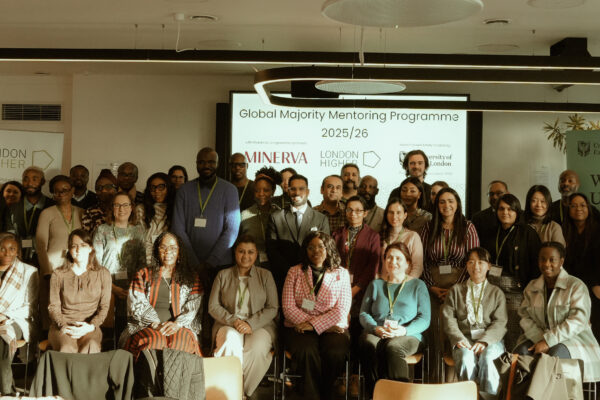
Global Majority Mentoring Programme 2025-2026

Global Majority Mentoring Programme 2024-25

#StudyNursingLondon campaign

Global Majority Mentoring Programme 2023-24

Wellbeing Connect

TfL Safer Travel at Night campaign

Situation in Ukraine

London Higher Global Majority Mentoring Programme 2021-22


